
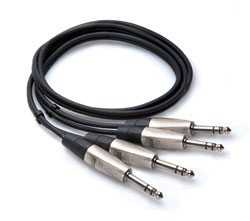
There is much confusion when one mentions the 1/4” connector. Guitar players and sound engineers are each seeking a certain type, but often have or are given the other. Let’s explore the simple 1/4″ connector that has come to complicate our world. We can start with how it is known: audio jack, phone jack, phone plug, jack plug. Specific types and variations include the stereo or mono plug, mini-jack, mini-stereo, headphone jack, longframe, tiny telephone (TT) connector and Bantam plug. Technically, the term “jack” refers to the female type (socket) whereas the word “plug” describes the male type (pictured), but the terms are often used interchangeably so we won’t split hairs.
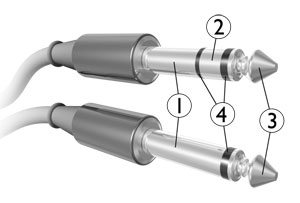 Let’s look at some terminology:
- The term 1/4″ (or 6.3mm) refers to the diameter of the plug or jack. Miniaturized versions include 1/8” (3.5mm) and 3/32” (2.5mm).
- The pointed end of the plug is called the tip (3), and the shaft is known as the sleeve (1). If the connector has two or more bands around the shaft (4), the space between them is called the ring (2). Each conductor will be wired in a specific way depending on the application. More on that in a moment.
- TS (Tip/Sleeve), or 2-conductor connectors, are typically used to transfer unbalanced mono analog audio signals.
- TRS (Tip/Ring/Sleeve), or 3-conductor connectors, are typically used to transfer balanced mono or unbalanced stereo analog audio signals.
- Albeit less common, 4- and 5-conductor connectors are used on some devices to transfer send and receive audio or for audio + video signals.
In their original application, 2-conductor 1/4″ plugs were used by telephone operators to connect one caller with another in the days of the manual telephone exchange. Today, common uses of 1/4” connectors include:
- Audio outputs for headphones and earphones (1/4” or 3.5mm TRS).
- Audio inputs on loudspeakers (1/4” TS).
- Line-level I/O connections on mixers, power amplifiers and signal processors (1/4” TRS or TS).
- Send/Return (Insert) points on mixing consoles (1/4” TRS or TS).
- Audio inputs and outputs on guitars, keyboards and instrument amplifiers (1/4” TS).
- Effects pedals for electric guitars and keyboards, and MIDI triggers for electronic drums (1/4” TS).
- Microphone inputs on portable audio recorders (3.5mm TRS or TS) and some entry-level audio equipment (1/4” or 3.5mm TRS or TS).
- Mic or line level I/O from PCs and laptops (3.5mm TS or TRS).
- Patch bay connections in audio and telecom applications (standard, longframe or TT/Bantam 1/4″ TS or TRS).
- Audio + video output on some consumer electronics devices such as camcorders and portable DVD players (3.5mm TRS or TRRS).
- Headphone or headset connections on cellular phones and mobile devices (3.5mm TRS or TRRS, occasionally 2.5mm TRS).
At this point, you may be wondering: what about the cable it’s wired to? We’re glad you asked. As stated earlier, the tip, ring and sleeve conductors are wired differently depending on the cable’s intended use. Here’s a wiring guide we borrowed from Wikipedia:
|
Unbalanced mono |
Unbalanced mono insert |
Balanced mono |
Unbalanced stereo |
|
| Tip | Signal | Send or Return signal | Positive/”Hot” | Left channel |
| Ring | Ground or No Connection | Return or Send signal | Negative/”Cold” | Right channel |
| Sleeve | Ground | Ground | Ground | Ground |
It’s also important to know that not all 1/4” cables are created equal! Even though the connectors on two cables may look identical, the cable type may not be. For example, guitar cables use a braided shield around a center conductor, and speaker cables use two unshielded wires with no braid. These cable types have different impedances, tolerances and other specifications that make them uniquely suited for their intended purpose. A guitar cable plugged into the output of a power amp pushing enough wattage can melt, and even start a fire! Always make sure the 1/4″ cable you are using is the right one for your application.
Hopefully this clears things up for you. So, when asked to “pass the 1/4” cable”, you are now armed with all the information you need.
Images courtesy of Hosa Technology.

Now I am confused. Loudspeaker cables are rarely ever shielded, in fact, many amplifier instruction manuals warn the user NOT to shield the cables which connect the output of the amplifier to the loudspeaker.
Scott, thank you for pointing out the error! You are indeed correct – the statement should have read “speaker cables use two UNsheilded wires with no braid”. We are fixing the post now.